

Keep up to date on our ultrasonic microphone

The Supertonic st258 ultrasonic microphone is currently in development.
The aim of the project is to produce an affordable alternative to high-end ultrasonic studio microphones.
Essentially, the goal is: more than 75% as good as a Sanken CO-100K, for less than 25% of the cost.
The current V4 prototype is close to achieving this, with a similar sensitivity and frequency response to the CO-100K, though there are still some bugs and shortcomings that I’m working on fixing in the next iteration. You can find some comparative measurements at the bottom of the page.
If you are interested in learning more about my progress in this project, there is a mailing list that you can join below.
Interested in purchasing a prototype microphone?
You can fill out the “join the waitlist” form below to send an expression of interest. Please read the disclaimers first though — these are experimental prototypes, and also in short supply. Filling out this form doesn’t commit you to anything, but here’s an idea of what you can expect from buying a prototype:
This is a work in progress, and there aren’t many prototypes to go around.
Currently this project is still in the R&D phase and production of prototypes is slow and infrequent. We are all out of builds of the current prototype, but future prototypes will offered to people in the order in which they signed up.
Every mic is different, some have peculiarities or flaws.
A lot of these prototypes are slightly different, as they are built for testing purposes, but I will provide you with details as to the particular flaws/bugs/oddities about the exact microphone that I offer you.
These prototypes are very much home-made.
My fingerprints are literally all over these, and while I am giving them the best finish I can achieve with my limited fabrication skills, they’re not all going to look as neat as I would like. If I offer you a mic, I will share photographs of it and explain its flaws first.
The warranty I can offer is fairly limited.
If your prototype mic is damaged in the post, or otherwise malfunctions or stops working, I will happily do my best to repair it free of charge. I will be able to offer a refund if you return the prototype to me, but only if the microphone is actually malfunctioning — I’ll try to make sure you understand the flaws and limitations of your microphone before you purchase, but I don’t have the bandwidth to handle change-of-mind returns.
There are still a lot of unknowns.
There are certain measurements that I don’t have the equipment to take, so I can’t provide an accurate frequency response chart, SNR, or max SPL rating.
There are no accessories (yet).
I have no windshields, lyre mounts, proper cases, or other peripherals for these prototypes; just a microphone that fits a standard shotgun clip.
You need an ultrasonic-capable recorder to get the most out of it.
This is an analogue microphone that has no ADC in it or USB connector, just a standard 3-pin XLR plug. To use it at all you need an audio interface or portable recorder with phantom power.
To capture ultrasonic frequencies, your recorder needs to be capable of running at a high sampling rate (at least 192k samples/second if you want the kind of results I get).
If you’re still interested despite all that, please feel free to list your name and email below and I’ll be in touch!
Join the waitlist to buy a prototype:
Frequently Asked Questions
When can I buy one?
I'm currently developing the next prototype. If all goes well I might be able to start building some to sell by the end of January 2027. There's a waitlist you can join by filling out the EOI form above, and new mics will be offered to the people at the top of the list first.
Can I buy an old prototype instead?
No, sorry. I have no spares to sell, I lack the materials to build more of them, and I want to focus on the next iteration.
How much does it cost to buy a prototype?
I haven't finalised the production costs for the next version yet. I'm aiming to keep it around $500, but I'm building each one by hand (except for the PCB), so I need to cover both the parts and my labour.
Can I have the schematics / PCB layout / BOM so I can build my own?
Sorry, but because the idea is not new (my circuit does a similar thing to the Sanken CO-100k circuit), I'm unable to patent my design and need to keep it secret for now.
Can you deliver to my country?
Maybe! I'm still sorting that out. There are probably places that I can't ship to from Australia.
I'm an influencer, can I have a free microphone in exchange for exposure?
Not at this stage, sorry!
Did you make this completely from scratch?
Not quite. The microphone capsule is produced by Primo, and the body is made out of copper plumbing parts. The bit I designed is the circuit that boosts the ultrasonic frequencies — which is what sets it apart from other budget ultrasonic microphones.
What is the exact SNR / Frequency Response / Max SPL?
I don't have the equipment and facilities to accurately measure most of those things, but I'm working on it. If you are able to help with this please get in touch!
Frequency response comparison: st258 V4.2 vs CO-100K
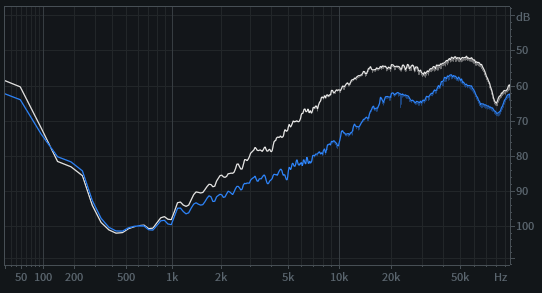
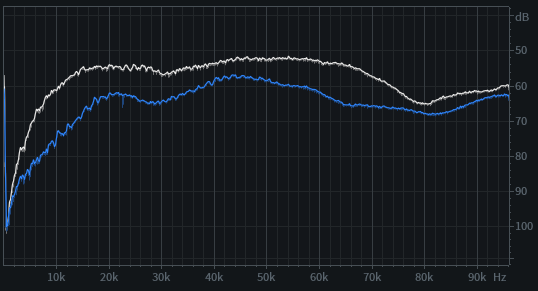
The best analysis I currently have of the frequency response is a shoot-out against a Sanken CO-100K. Both microphones were recording an air hiss at the same time from the same distance at the same gain. The response below 1kHz is very similar for both microphones, with the st258 (white line) becoming more sensitive in the upper frequencies. The pattern is quite similar for the room tone recording, which is just capturing the ambient noise in my studio.
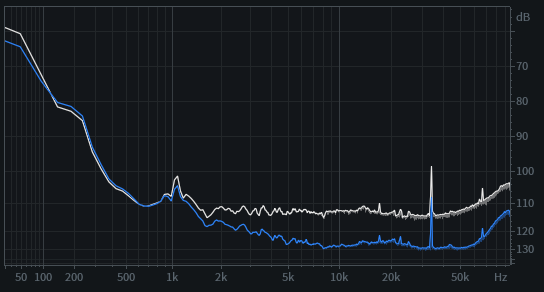
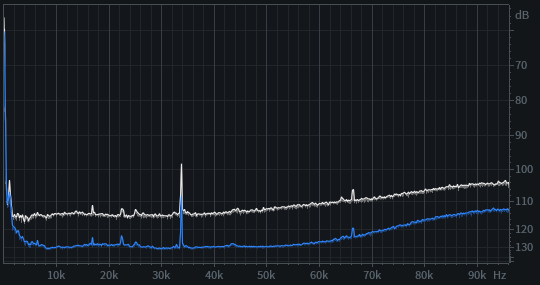
In terms of SNR, as far as I can tell from my various test recordings neither microphone sounds significantly noisier than the other, but without a quiet environment I can’t be sure what the actual figures are.
If you want to do your own analysis, here are the raw files for the hiss recording and room tone recording:
And here is a recording of a typewriter with both mics, progressively pitched down so you can hear how they compare:
Note: I did adjust the gain of the right channel (CO-100K) of the typewriter recording so that both channels would have the same overall RMS, but apart from that no noise reduction or other processing has been done on any of these recordings.